
News & Updates
Fundraising appeal video
This Thursday saw the launch of our crowdfunding appeal to bring the kiln home. Find out more (and how to help) in our video.
The Ham and High welcomes our crowdfunding launch!
Hampstead and Highgate's local paper gives a warm welcome to the launch of our crowdfunding programme on 1st July.
The Classical Association sponsors FOHRK's Great Roman Online Pottery Challenge
We are delighted to announce that the Classical Association has sponsored FOHRK's Great Roman Online Pottery Challenge most generously, making it possible for us to run the programme in full, and giving us every chance of being able to make the project available to schools and communities across the UK, after its piloting as a North London initiative.
Launching on the 1st July 2021: The Great Roman Online Pottery Challenge
Launching on the 1st July 2021: The Great Roman Online Pottery Challenge
A two-phase, cross-disciplinary education project centred around the Roman archaeology in Highgate Wood, aimed at schools and community groups across North London, making extensive use of online technology.
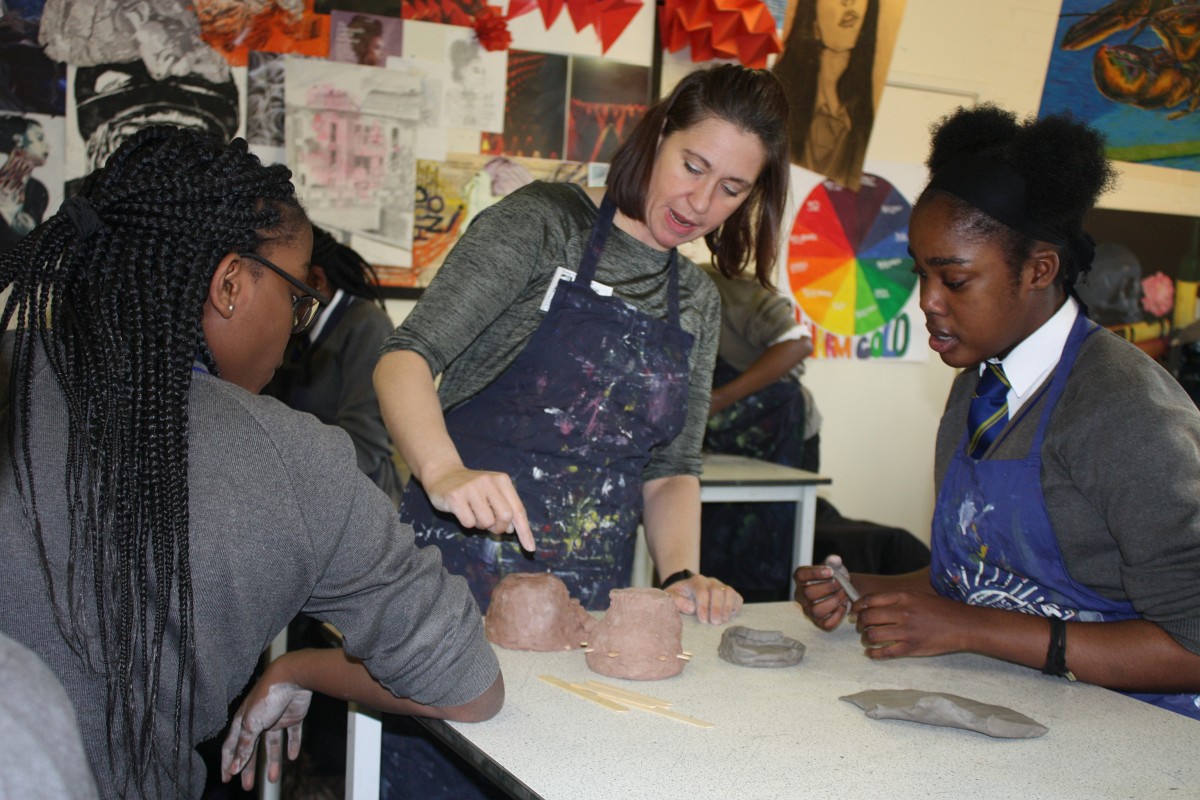
We are determined that our activities will be accessible to, and engaging for, the widest possible range of people, including schools. We are working with partners to develop cross-curricular learning resources for different key stages, with a number of new curriculum materials covering history, visual arts, language and science. The recent Clay Club pilot project showed that there is great appetite for these learning programmes and resources. Greig City Academy Clay Club www.highgateromankiln.org.uk/learning.php
The Great Roman Online Pottery Challenge
Phase 1 – online pottery class
To celebrate the launch of the FoHRK Crowdfunding campaign on 1st July 2021, a 60-minute online pottery masterclass will inform attendees about the Roman finds in Highgate Wood – the kilns (the science and the excavation, including using existing evidence to make deductions about Romano-British life) and the pottery (profiles, materials, uses and dispersal beyond the local area). The session will then guide the participants through the process of making a replica Roman Highgate-ware vessel in air-drying clay using tools and techniques available to Romano-British craftsmen. This synchronous event would be recorded and subsequently edited to form the basis of Phase 2 of this project. Holding the event online makes the event Covid-secure, and allows a greater number of participants from school and community groups. Members of FoHRK (all of whom are volunteers) will provide archaeological/historical materials and knowledge in the session. Duncan Hooson of Clayground Collective and Central St Martins will provide the technical pottery and clay-work knowledge.
Phase 2 – asynchronous class materials development & competition
The video from the online pottery class would be edited into an instructional video with supporting teacher and student materials. Schools could apply for a clay grant to run the session in their schools with no cost to the school. Schools will then submit their entries to a competition for the best effort. Although initially a local project, the asynchronous materials could be disseminated more widely (e.g. to KS2 students studying the Romans) and the approach replicated if successful. Trustee Charlie Andrew has links with schools throughout the country, as well as with various online content download platforms.
Claire Skinner and Hugh Dennis become patrons of FOHRK
We are delighted to welcome Claire Skinner and Hugh Dennis as the first patrons of the Friends
of Highgate Roman Kiln. The support of the stars of 'Outnumbered' and many other successful
shows is a huge boost to our campaign to bring the kiln back to Highgate Wood.
Officials in London managed Highgate Wood in Roman times, says Harvey Sheldon
At a meeting of the West Essex Archaeological Group on 8th March, 2021, FOHRK trustee Harvey Sheldon argued strongly that the Procurator's Office in Londinium managed Highgate Wood, rather as the City of London looks after it now. The Procurator was a senior official, with responsibility for budgets, tax and imperial estates. Timber was so vital - for building, boat-building,heating, cooking and many other purposes - that woodland near cities and large towns was likely to be incorporated in imperial estate management schemes.
Hello Charlie
We welcome Charlie Andrew from Classics for All as a Trustee of the Friends of Highgate Roman Kiln. Charlie has been involved with the project for over a year now, advising on learning opportunities for schools, and creating a pilot project ‘Clay Club’ with Greig City Academy. She brings a wealth of experience and contacts with her, as well as her passion for all things classics and educational! We are very much looking forward to her input!
Classics for All supports state schools across the UK, many in areas of socio-economic disadvantage, to introduce or develop the teaching of classical subjects sustainably on the curriculum or as an after school activity.
Covid-19
 We started 2020 so well with a positive response to an initial ‘Expression of interest’ we sent to the National Lottery Heritage Fund (NLHF) and some really great consultations about what people might want to see and do as part of this project!
Then Covid19 hit and priorities changed. Despite this slight setback putting our funding applications to the NLHF and other organisations on hold (NLHF are currently supporting heritage organisations who need financial support to survive) we are still busy working away in the background!
High praise for Tony and Harvey’s book!
Harvey Sheldon and Tony Brown were awarded the John Gillam Prize in 2019 for their publication ‘The Roman Pottery Manufacturing Site in Highgate Wood: Excavations 1966-78'.
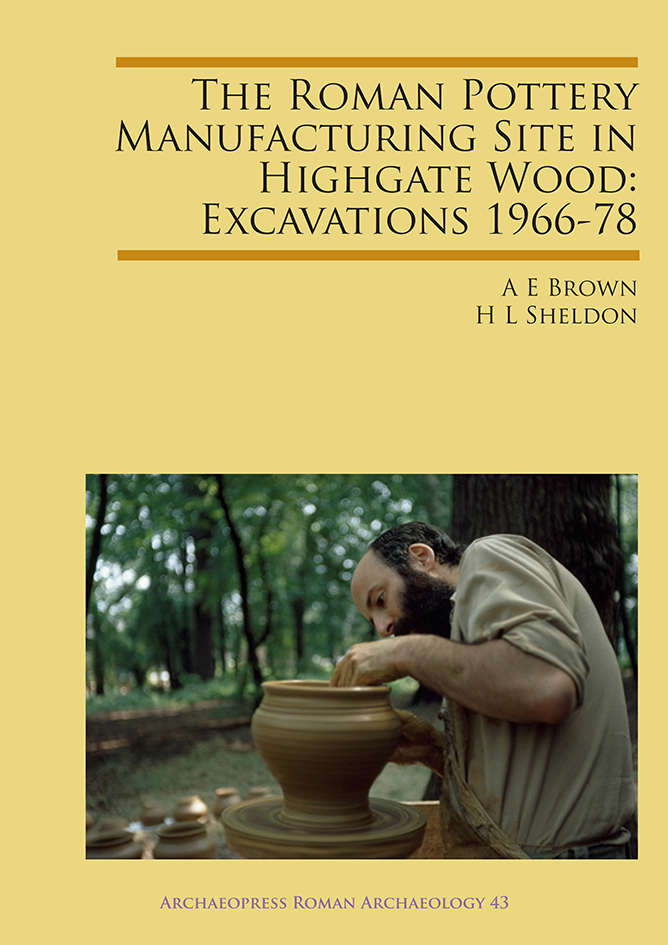
Through the annual John Gillam Prize, established in 2004, the Study Group for Roman Pottery honours authors who make a major contribution to the subject. The winners generously donated their £150 prize to The Friends of Highgate Roman Kiln
Found on the shores of Kent...
Mudlarker Steve Trim has kindly provided us with this account of his fascinating discovery of a ‘Highgate Wood style beaker’ on the Thames foreshore in Kent.
"Several years ago, while walking the foreshore along the Thames Estuary in Kent, I came across a pot base exposed by erosion. Knowing that Roman material had been recorded as being found from this particular spot I carefully dug around the base and extracted it from the thick gloopy clay that makes up this part of the Thames.
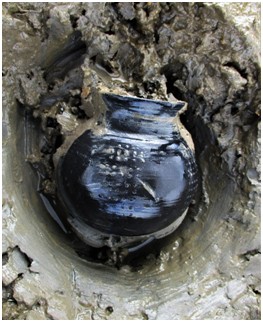
Luckily, there were several other pieces of this vessel in the mud beneath the base and I soon managed to reconstruct most of the pot from these sherds – revealing a rather nice Roman poppyhead beaker.
During a subsequent visit to the Museum of London I found an identical (but larger) beaker on display; listed as being made in the Highgate Wood area of North London. These beakers were made by the Highgate Wood potters during the 2nd Century.
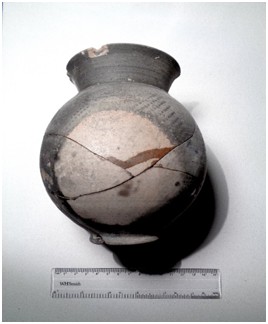
The pale circle on the front of the beaker is due to the vessels having been stacked alternatively vertically/horizontally in the kiln – the circle being where the mouth of the adjacent vessel was stacked alongside.
These vessels are commonly found during archaeological investigations in London but are rarely found in the part of Kent where this particular beaker was discovered – although several years later a nice sherd of a similar beaker, but highly burnished and black in colour, was found just a few feet away from the original find-spot. There is a strong possibility that this beaker was made by the Highgate Wood potters as well.